AI & strategy Arjan·Managing Director
Why your AI chatbot frustrates customers more often than it helps
Arjan·Managing Director Google Premier Partner
 Meta Business Partner
95% of AI pilots deliver no result, not because of the tool but because the process is missing. How to build an AI workflow in marketing that actually works.
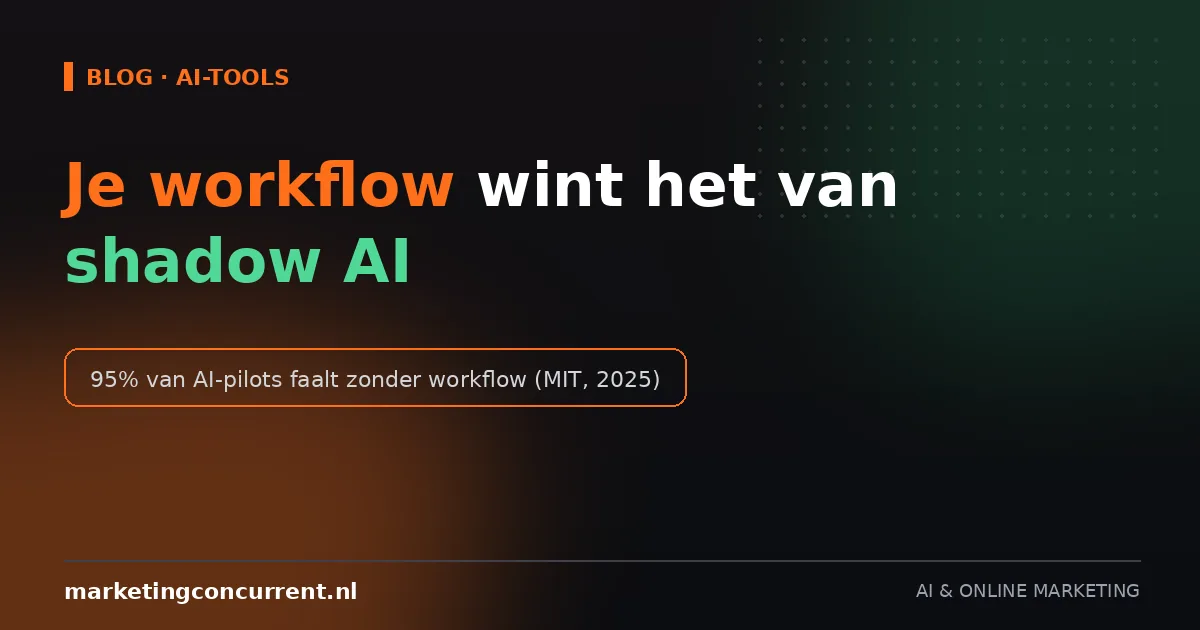
Almost every marketing team now uses AI, and yet for most teams it still produces no measurable advantage. Adobe examined this for its report The State of Marketing in an AI-Driven World, and the conclusion was painful. More than eight in ten marketing teams say they missed at least one opportunity in the past quarter, despite all the AI tools they already use. A 2025 MIT report, The GenAI Divide, saw the same pattern more broadly across business. There, 95 percent of generative AI initiatives showed no demonstrable result. The problem rarely lies in the tool itself. It lies in the absence of a workflow around it.
Marketing teams stack tools on top of each other. A chatbot for text, a separate subscription for images, a plugin for social copy, all side by side. Each tool is tried out separately, usually by one enthusiastic employee, without anyone recording who checks the output or when that tool may actually be used. In its report, Adobe points to fragmented systems, disconnected approval rounds and manual intermediate steps as the main reason speed drains away between the idea and publication. The AI step itself is lightning fast. The rest of the process around it is still exactly as slow as three years ago.
The MIT researchers draw a similar line between the 5 percent that do achieve results and the rest. The difference is not in which model those companies use, but in how far AI is embedded in a recurring business process with a clear owner. Companies that have woven AI deep into the back office, in order processing or customer communication for example, do see results. Companies that mainly place AI alongside existing work remain stuck in isolated experiments.
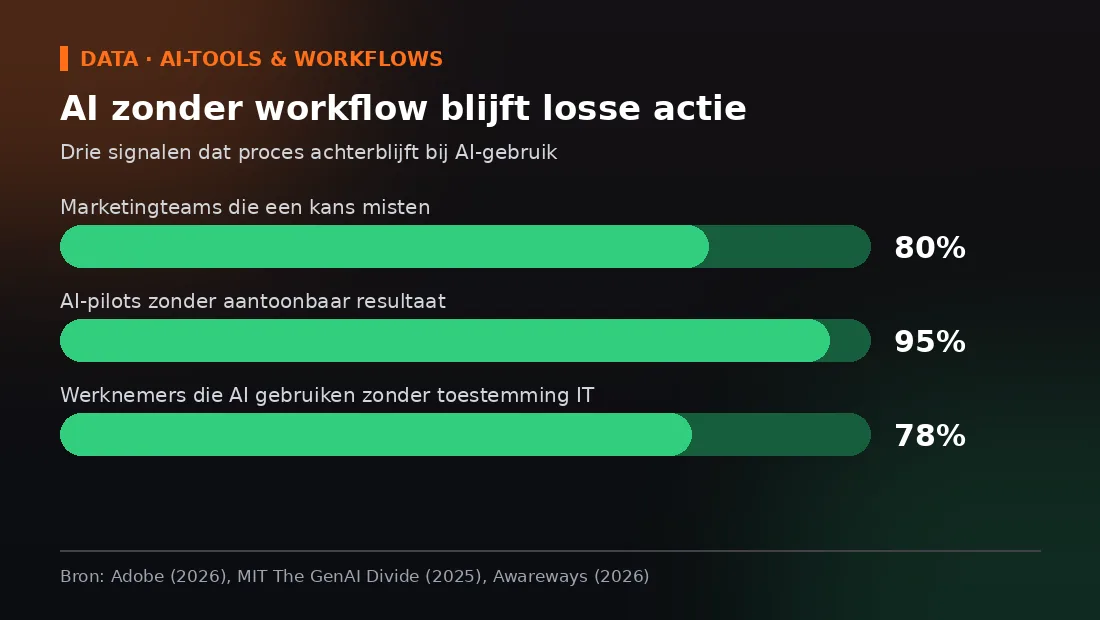
This lack of structure also has a downside that few marketing teams have on their radar. Research by Awareways from March 2026 shows that 78 percent of employees use AI without permission from the IT department, and that organisations have visibility of less than 11 percent of the actual AI use within their own walls. For marketing, that means things like copy, customer data or brand guidelines being pasted into a public chatbot without any agreement in place. Not because people want to be careless, but simply because there is no process that says what is and is not allowed.
The difference between the 5 percent of companies that do achieve results with AI and the rest is not in the model, but in whether AI is embedded in a process with a clear owner.
A sustainable AI workflow in marketing does not have to be big. Five elements make the difference between a loose experiment and a process you can build on.
What we often see in marketing teams is that the first four points are perfectly in order and the fifth is skipped. Everyone uses AI, nobody has agreed who is responsible for what, and so under pressure quality still falls back on whoever happens to have time.
Take content production as an example, because that is where most teams have been experimenting with AI the longest. A workflow without a process looks roughly like this. A marketer opens a chatbot, types a prompt, pastes the output into the CMS and publishes after a quick glance. If it works, it is luck, not a system.
A workflow with a process fixes four steps. The briefing always contains the target audience, core message and intended channel, so the AI does not have to guess. The first draft comes from a fixed, shared prompt rather than an ad-hoc wording that sounds different for everyone. An editor checks not only spelling but tests facts, brand tone and legal claims against a fixed checklist. Only after that step does the piece go to publication, with a note on which parts were AI-assisted, which ties in directly with the transparency obligation that has applied since August to certain AI content. The same structure works for campaign copy, email flows or social captions. Always the same fixed input, the same template, the same review and the same record afterwards.
In budget terms this asks for little extra. The tools are usually already there; what is missing are the agreements around them. Count on half a day per process to put the four steps on paper, and on a shared prompt archive in a tool the team already uses, such as a shared drive or the internal wiki. Large governance software only becomes relevant for most SMB marketing teams once several departments are involved.
Track three figures per process: the lead time from briefing to publication, the number of times a piece still had to be corrected after publication, and the time an editor spends on review per piece. If lead time falls without corrections rising, the workflow is working. If lead time stays flat or the number of corrections goes up, the problem is not the AI but a step that is still missing or not clearly assigned.
Read also: Why your AI chatbot frustrates customers more often than it helps, an example of a tool without a working workflow.
No, and that is exactly the trap. Choose one repeatable process, such as content production or lead follow-up, and build a small number of fixed steps around it. The tool is interchangeable, the process is not.
Agree explicitly which tools are approved, which data may and may not go into them, and who can answer questions about new tools. A simple list of three to five approved tools works better than a ban, because a ban without an alternative pushes usage underground.
No. A prompt library is an aid within a workflow, not a replacement for one. Without agreements on who checks the output and when, even a good prompt still depends on whoever happens to be at work.
Founder and managing director of MarketingConcurrent, building AI tooling for marketing and e-commerce with AIbove and DropMetrics. Questions about this article? Book a strategy call or meet the whole team.
Arjan·Managing Director