
ChatGPT Ads Damien·Team Lead SEA
ChatGPT Ads are live in the Netherlands and across Europe: what you can do now
Damien·Team Lead SEA Google Premier Partner
 Meta Business Partner
Checkout inside ChatGPT is failing: conversion is 3x lower than on your own site. Why discovery via AI does work and where your budget should go now.
In September 2025 OpenAI announced with great fanfare that people would be able to pay for products without leaving ChatGPT. Six months later the company quietly withdrew the feature, citing a lack of flexibility. By then Walmart had measured that a checkout inside ChatGPT converted roughly three times worse than clicking through to walmart.com. For online retailers that is no reason to ignore agentic commerce, but it is a reason to put the budget somewhere other than where most agencies currently advise. Do not build your own till inside the chatbot. Make sure your products are found and recommended there, organically or through ChatGPT advertising, while the actual purchase simply keeps happening on your own site.
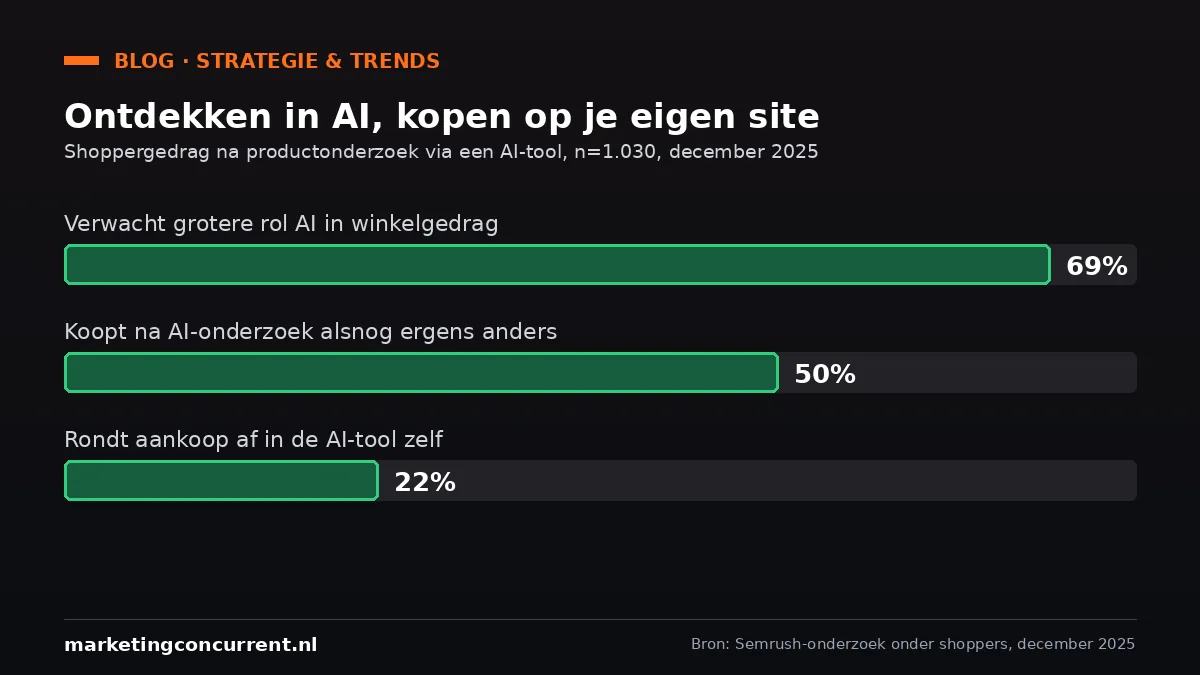
That distinction between finding and buying is exactly what the numbers point to. At the end of 2025 Semrush surveyed more than a thousand shoppers and found that 50 percent, after researching through an AI tool, still bought somewhere else, usually directly from the retailer. Only 22 percent completed the purchase inside the AI tool itself. At the same time, 69 percent expected AI to play a bigger role in their shopping behaviour. So people are happy to take advice from a chatbot, but when it is time to pay they prefer to return to familiar ground.
The Agentic Commerce Protocol, developed by OpenAI together with Stripe and available as open source since September 2025, was meant to be the bridge between retailers' product feeds and the chatbot. Target, Sephora, The Home Depot and Etsy signed up, and through Shopify brands such as SKIMS, Spanx, Glossier and Vuori were queuing up. In practice, however, only around thirty Shopify merchants ever went live with instant checkout, against the million that had been held out at launch.
Trust turns out to be the bottleneck. The same consumer research shows that 41 percent are sceptical about autonomous AI purchases and 33 percent are outright distrustful. Shoppers who do trust an AI agent with their money set their own limit, and the median limit sits around fifty dollars. For a retailer selling higher-priced products, which describes most retailers, that is a narrow window to build on.
Discovery is increasingly happening in the AI chat, but for now the actual purchase still takes place on the seller's own site.
While checkout stalls, the use of AI for product research is growing fast. Search volume for AI shopping rose by more than 1,700 percent over the past two years, and 63 percent of AI users now use a chatbot to compare products before they buy. In the Dutch trade press, Coolblue and bol.com are already being named as players that could lose part of their role as comparison platforms to ChatGPT and Gemini, even though hard figures specific to the Dutch market are still lacking.
What we often see among marketers is that these two developments get mixed up. The budget goes to a flashy checkout integration, while the gains lie in something dull: making sure an AI agent can actually find, compare and recommend your product in the first place. Walmart's own figures support that argument. Despite the lower conversion, traffic from ChatGPT brought in twice as many new customers as traffic from regular search results. So the channel does work, just differently from what the initial launch promised.
A product feed that an AI agent can read looks like a good Google Shopping feed, but with slightly different priorities. Price and stock must be current, because a chatbot that quotes a wrong price costs you more trust than a human buyer would ever forgive. Reviews and ratings carry more weight, because a language model often uses them to substantiate a recommendation. And product descriptions work better when they name specific features instead of marketing language, simply because an AI agent has to match those features to a user's question.
For the average online store, cleaning up the product feed and structuring reviews is a sprint of a few days for a developer and a content specialist working together. Building your own checkout connection is a multiple of that, with the risk that the protocol you build on has been changed again within a year.
In GA4, segment traffic from chatgpt.com, gemini.google.com and perplexity.ai separately from regular organic traffic, and compare not only the conversion rate but also the share of new customers, as Walmart did. A lower conversion rate with a higher share of new customers can still be a good outcome. Also track how complete your product feed is. The percentage of products with current stock, price and at least five reviews is a simple monthly metric that maps directly onto what an AI agent needs in order to recommend you.
Want to know where your store stands in AI answers today and where the budget will deliver the most? Book a strategy call.
For most online stores, not yet. Only a small number of Shopify merchants are actually live, conversion inside the chat is considerably lower than on your own site, and competing standards from Google and Visa are still in development. Invest first in product data that AI agents can read, and follow the race towards a winning standard before you build a technical integration.
No. Agentic commerce is about whether an AI agent can complete a purchase on the user's behalf, through protocols such as the Agentic Commerce Protocol. Advertising in ChatGPT is a separate, paid channel with its own buying process. Both affect your strategy, but they call for different budget decisions and different KPIs.
Ask ChatGPT, Gemini and Perplexity a number of realistic buying questions directly and note whether and how your brand is mentioned. Combine that with the GA4 segmentation on chatgpt.com, gemini.google.com and perplexity.ai to see how much of that traffic actually clicks through to your site.
Leads the SEA team and manages Google Ads accounts for online stores and dropshippers every day, from Shopping structure to bidding on margin. Questions about this article? Book a strategy call or meet the whole team.
Damien·Team Lead SEA
 Sander·Team Lead SEO, GEO & Website
 Ruben